

Blog
How Do You Say Hello In Bavarian German?


In Bavarian German, the most common way to say hello is “Servus” (informal, used with friends and strangers alike) or “Grüß Gott” (formal, literally “God greet you”). Bavarians rarely use the standard German “Hallo” — greetings here carry regional identity, so learning the right one instantly signals cultural respect.
Bavaria doesn’t just speak German — it speaks Bavarian, a dialect family with its own rhythm, warmth, and unwritten rules about who says what to whom. Whether you’re heading to Oktoberfest, planning a trip through the Alps, or simply curious about Bavarian culture, knowing how locals greet each other is one of the fastest ways to feel less like a tourist and more like a guest who belongs.
This guide breaks down every major Bavarian greeting — formal, casual, regional, and seasonal — with pronunciation, context, and real usage examples, reflecting how people actually speak in Bavaria today. Unlike a plain vocabulary list, this covers when to use each greeting, why Bavarians choose one over another, and how the dialect has quietly shifted as younger speakers mix tradition with modern slang. It also looks at the small social signals — tone, timing, body language — that turn a simple word into a genuine gesture of respect, since in Bavaria, how you say hello often matters as much as which word you choose.
For many travelers, the appeal of Bavaria lies precisely in these small rituals. Unlike the more clipped, business-like greetings common in northern Germany, Bavarian hellos tend to carry warmth and a sense of belonging, even between strangers. A shopkeeper greeting a customer, a hiker passing another on an Alpine trail, or a group of friends meeting at a beer garden will all reach for slightly different words — and recognizing those differences is part of what makes learning Bavarian greetings genuinely useful rather than just decorative vocabulary. For those planning to look the part while they practice these greetings, browsing traditional lederhosen for men or dirndl dresses for women is a natural next step before any trip to Bavaria.
Where Bavarian Greetings Come From
Bavarian German isn’t a “broken” or simplified version of standard German — it’s a distinct dialect group (Bairisch) with roots stretching back over a thousand years, shaped by Bavaria’s history as an independent kingdom until 1918. Many of its greetings carry religious or historical weight that outsiders rarely notice. “Grüß Gott” literally invokes a blessing, coming from the older phrase “Grüß dich Gott,” meaning “May God greet you.” Its religious tone reflects Bavaria’s strongly Catholic history, and it’s still common to hear it in churches, small villages, and among older generations. “Servus,” by contrast, actually predates German entirely — it comes from Latin, where it meant “(I am) your servant,” a courtly phrase absorbed into Austro-Bavarian speech centuries ago and eventually flattened into a casual, all-purpose hello. Dialect greetings like “Griaß di” and “Hoi” evolved from these older forms as regional accents softened consonants and shortened vowels over generations.
Understanding this history isn’t just trivia — it explains why Bavarians treat greetings as more than small talk. A “Grüß Gott” carries centuries of local identity, which is part of why it hasn’t been replaced by the more neutral “Hallo,” even as younger generations adopt more casual speech. Linguists who study Bavarian dialects often point out that greetings are among the last features to disappear even as a dialect otherwise fades under the influence of standard German, precisely because they’re tied so closely to identity and community rather than pure communication. That’s also why greetings tend to survive migration: Bavarians who move to other parts of Germany, or abroad, often keep using “Servus” long after they’ve otherwise adapted their speech.
The Two Core Bavarian Greetings You Need to Know
| Greeting | Type | When to Use | Literal Meaning |
|---|---|---|---|
| Servus | Informal | Friends, peers, casual settings — hello and goodbye | Latin: “at your service” |
| Grüß Gott | Formal | Elders, authority figures, shops, business | “Greet God” / “God greets you” |
| Griaß di | Semi-casual | Familiar but respectful (singular “you”) | “Greet you” (dialect form) |
| Griaß eich | Semi-casual, plural | Greeting a group of friends | “Greet you all” |
If you only remember two words before visiting Bavaria, make them Servus and Grüß Gott. Everything else is a regional or situational variation on these two anchors.
Formal Greetings in Bavarian German
Formal greetings matter more in Bavaria than in many other German-speaking regions, where hierarchy, age, and tradition still shape everyday speech.
- “Grüß Gott” — the standard formal greeting, used in shops, offices, churches, and with anyone older or unfamiliar. Pronounced roughly [grüs got].
- “Grüß Gott zusammen!” — used when greeting a formal group, common in Upper Palatinate and business settings.
- “Guten Tag” — standard German for “good day,” understood everywhere but seen as slightly more neutral or “big-city” than “Grüß Gott.”
- Adding “Herr” (Mr.) or “Frau” (Ms./Mrs.) before a name after the greeting increases the level of respect — common when addressing elders or professionals.
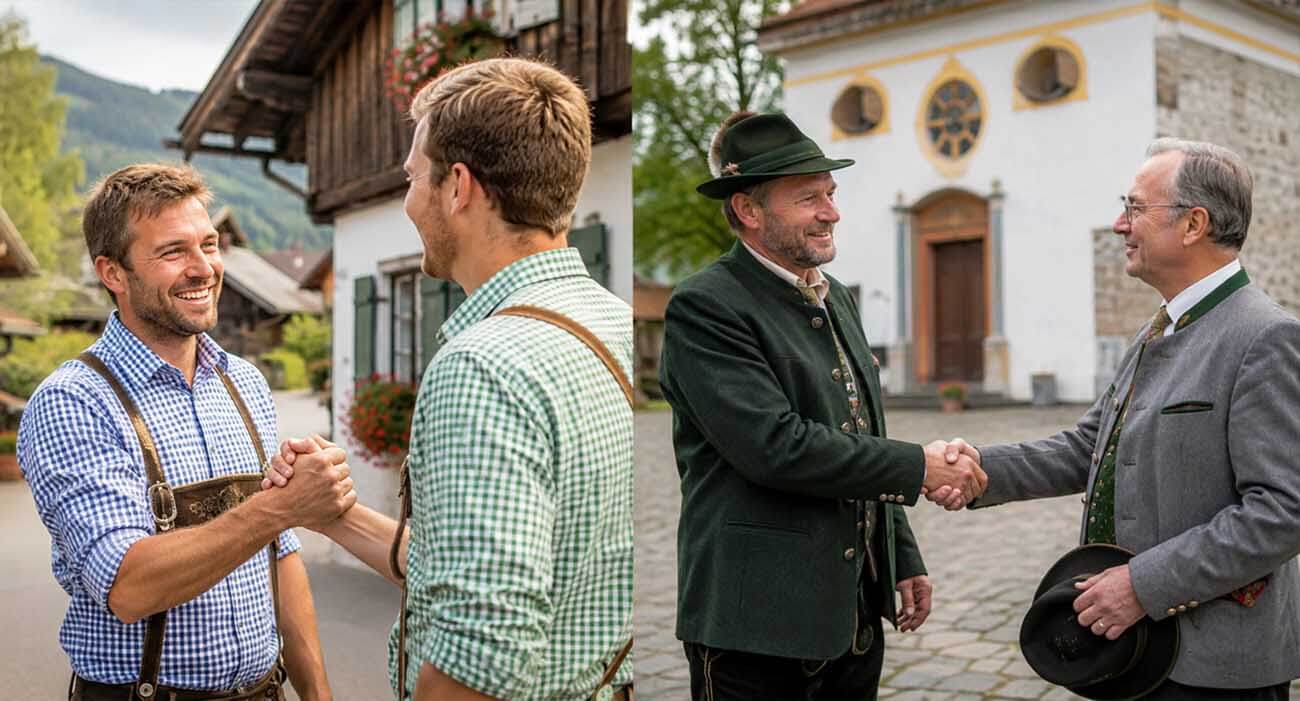
Time of day rarely changes the greeting itself — “Grüß Gott” works from morning to evening — but tone and body language do. A firm handshake, direct eye contact, and a brief nod typically accompany formal greetings in Bavaria.
Casual Greetings Bavarians Actually Use Every Day
Informal Bavarian greetings are where the dialect really comes alive. These are the words you’ll hear at markets, beer gardens, and among friends.
- “Servus” — the single most common casual greeting in Bavaria, usable for both hello and goodbye. Works with strangers, friends, shopkeepers, and colleagues alike.
- “Griaß di” — a warm, dialect-flavored “hello,” slightly more personal than “Servus.”
- “Hoi” — heard especially in southern Bavaria and near the Alps; short, friendly, casual.
- “Servas” — an Austrian-influenced variant used along the Bavarian-Austrian border.
- “Moin” — technically a northern German greeting, but increasingly heard among younger Bavarians due to migration and social media culture.
Younger Bavarians also mix dialect with standard German more freely than in the past, especially in cities like Munich, where “Hallo” and “Servus” are used almost interchangeably depending on the crowd.
Regional Variations Across Bavaria
Bavaria is not linguistically uniform — greetings shift noticeably by region, and getting this right shows a deeper level of cultural awareness. In Upper Bavaria (Oberbayern), “Grüß di Gott” or simply “Servus” reign as the heartland of classic Bavarian greetings. In Franconia (Franken), “Servus” is common, though locals may also use close-circle slang informally, while formal settings still favor “Grüß Gott.” Swabia (Schwaben) leans toward “Griasdi” or “Griaß di,” reflecting overlap with Swabian-German dialects, while the Allgäu region is known for “Hoi” alongside standard Bavarian greetings. In Lower Bavaria and the Upper Palatinate, “Grüß Gott zusammen!” remains the go-to formal greeting for groups.
Using a hyper-local greeting correctly — like “Hoi” in the Allgäu or “Griasdi” in Swabia — often gets a warmer reaction from locals than the more generic “Hallo,” because it signals genuine familiarity with the region rather than textbook German. These regional differences aren’t just academic trivia either; they reflect centuries of separate settlement patterns, trade routes, and even church diocese boundaries that shaped how communities spoke to one another long before national borders standardized the language. Visitors who travel across multiple Bavarian regions in a single trip — say, from Munich down to the Allgäu — will often notice locals subtly switching greeting styles depending on who they’re addressing, which is itself a small window into how deeply place and identity are woven into everyday Bavarian speech.
Greetings for Oktoberfest and Special Occasions
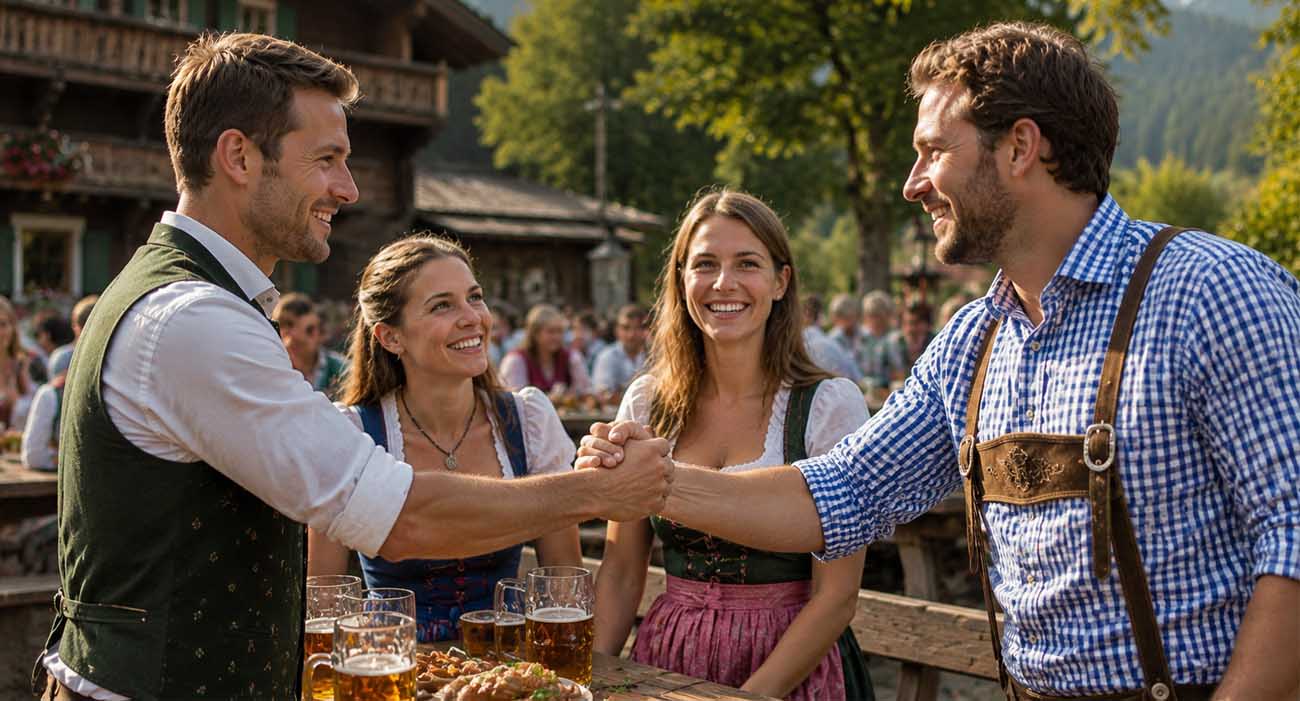
Certain greetings only appear during specific festivals or seasonal moments, and knowing them adds authenticity to any visit. “O’zapft is!” is shouted by Munich’s mayor to open Oktoberfest each year — it means “It’s tapped!” and marks the first keg being opened. “Prost!” isn’t a greeting exactly, but it’s the essential toast (“Cheers!”) heard constantly during the festival. “Mia san mia,” meaning “We are who we are,” is a phrase of regional pride often used at festivals, sports events, and community gatherings. For religious holidays, Bavarians use “Frohe Ostern” (Happy Easter) or “Frohe Weihnachten” and “Frohes Fest” around Christmas. At folk festivals, you’ll also hear “Auf geht’s!” — “Let’s go!” — as a common rallying cry.
Arriving at Oktoberfest with “Servus,” “Prost,” and “O’zapft is!” already in your vocabulary puts you ahead of most international visitors. Greetings are just one small piece of Oktoberfest etiquette, though — visitors curious about other unspoken customs might also want to read about what the apron tie on a dirndl actually signals, another detail locals notice immediately.
How to Pronounce Bavarian Greetings
Getting the sound right matters as much as the word itself. “Servus” is pronounced roughly SER-voos, while “Grüß Gott” comes out as “grüs got,” with a soft “ü” and a short “o.” “Griaß di” sounds like “gree-ahs dee,” and “Hoi” is said much like the English word “hoy.” “Mia san mia” is pronounced “MEE-ah zahn MEE-ah,” and “O’zapft is” comes out as “oh-tsapft iss.” In general, the Bavarian “r” is softer and less rolled than in standard German, vowels tend to be shortened, and stress usually falls on the first syllable. Listening to native speakers on platforms like YouTube or Bavarian-language podcasts remains the fastest way to internalize the rhythm.
Etiquette: What Bavarian Greetings Say About Respect
Bavarian greetings are inseparable from body language and social hierarchy. Handshakes are standard for formal greetings, especially first meetings or professional contexts, and eye contact while greeting signals sincerity — looking away can read as dismissive. Titles matter too: using “Herr” or “Frau” with a surname after “Grüß Gott” shows added respect toward elders or authority figures. Cheek kisses or light hugs are reserved for close friends and family, not first-time or formal encounters. Reciprocity is also expected — if someone greets you with “Servus,” it’s best to respond in kind rather than switching to English or standard “Hallo,” which can come across as distancing. Volume and pace matter too: Bavarian greetings are typically delivered at a relaxed, unhurried pace rather than clipped short, which reflects the region’s generally slower, more sociable approach to daily interactions compared to faster-paced German cities further north. Visitors who rush a greeting, or treat it as a mere formality to get through, sometimes come across as brusque even without meaning to. Respectful greetings often go hand in hand with dressing appropriately for the occasion too — for anyone deciding what to wear alongside their Bavarian hellos, it’s worth comparing dirndl versus lederhosen options for women before a festival or formal event.
Common Mistakes Learners Make
Even well-prepared visitors slip up on a few predictable points. Overusing “Hallo” is understood everywhere, but leaning on it exclusively can make you sound like you haven’t engaged with the local culture at all — locals notice the difference. Using “Servus” in strictly formal or religious settings is another common misstep; it’s casual by nature, so it’s better swapped for “Grüß Gott” in churches, government offices, or with clearly older individuals. Mispronouncing the “ü” in “Grüß” is common too — English speakers often flatten it into a plain “u,” when the correct sound is closer to a rounded “ee” said with pursed lips. Many learners also assume one dialect fits the whole state, when a greeting that’s perfectly natural in Munich (Upper Bavaria) can sound slightly out of place in Franconia, which has its own distinct dialect and cultural identity. Finally, visitors sometimes forget that “Servus” also means goodbye, leading to confusion when a shopkeeper says “Servus” while they’re leaving. This kind of assumption is common with Bavarian culture more broadly — much like the greetings themselves, popular beliefs about traditional dress are often oversimplified too, which is exactly what this myth-busting look at who really wears lederhosen sets out to clarify.
Bavarian vs. Standard German Greetings at a Glance
| Situation | Standard German | Bavarian German |
|---|---|---|
| Casual hello | Hallo | Servus |
| Formal hello | Guten Tag | Grüß Gott |
| Hello to a group | Hallo zusammen | Grüß Gott zusammen |
| Casual goodbye | Tschüss | Servus / Pfiat di |
| Formal goodbye | Auf Wiedersehen | Auf Wiederschaun |
Notice that “Servus” and “Pfiat di” (a Bavarian farewell meaning roughly “God protect you”) both double as goodbyes — a small but telling example of how Bavarian dialect compresses meaning into fewer, more versatile words than standard German.
Practical Tips for Learning Bavarian Greetings
Learning Bavarian dialect has become easier thanks to digital tools and content built specifically around regional German. Language apps like Babbel and Duolingo now include dialect-aware modules, though Bavarian-specific content is still best supplemented with native media. Short-form video platforms such as YouTube Shorts, TikTok, and Instagram Reels have Bavarian creators posting quick pronunciation and slang breakdowns, which is useful for picking up natural rhythm fast. Language exchange communities connect learners directly with Bavarian native speakers for real conversation practice, while immersion trips — even a few days in Munich, Nuremberg, or the Allgäu region — accelerate greeting fluency faster than any app, since tone and context are half the skill. Above all, practicing out loud rather than just in your head matters, since Bavarian greetings rely on a rhythm and softness that reading alone won’t teach. For more on Bavarian traditions, dress, and festival culture, browsing the Alpen Lederhosen blog is a good next step once you’ve got your greetings down.
Quick-Reference Summary
Servus remains the most common informal greeting, while Grüß Gott is the standard formal choice. For the Alps specifically, Hoi is the regional pick worth knowing, and O’zapft is! is the one festival greeting every Oktoberfest visitor should recognize. Above all, the one rule to remember is to match the formality level of the person greeting you — Bavarians notice.
Frequently Asked Questions
Servus” is the most widely used informal greeting across Bavaria, while Grüß Gott is the standard formal greeting.
It’s mainly heard in Bavaria and parts of Austria; the rest of Germany typically uses “Hallo” or “Guten Tag.
Tourists are welcome to use “Servus” — locals generally appreciate the effort, and it’s considered friendly rather than presumptuous.
Yes, though usage has blended with standard German and even northern slang like “Moin,” especially in cities like Munich.
Servus” is casual and versatile (used for both hello and goodbye), while “Grüß Gott” is formal and typically reserved for elders, authority figures, or first meetings.
Yes — “O’zapft is!” (“It’s tapped!”) marks the festival’s opening, and “Prost!” is the essential toast used throughout the celebration.
Yes — it’s one of the few Bavarian words that works for both, which is part of why it’s so widely used in everyday conversation.
It’s classified as a dialect group (Bairisch) rather than a separate language, but it has distinct vocabulary, pronunciation, and grammar quirks that can be hard for standard German speakers to follow at first.
Final Thoughts
Bavarian greetings are more than vocabulary — they’re a quick, low-stakes way to show that you respect local identity. Start with “Servus” for everyday moments and “Grüß Gott” for anything formal, then layer in regional touches like “Hoi” or “Griasdi” once you’re comfortable. Whether you’re preparing for Oktoberfest or simply deepening your appreciation of Bavarian culture, mastering these greetings is the first real step toward feeling at home in Bavaria. If you’re also putting together your festival outfit, take a look at women’s Oktoberfest shirts and men’s trachten shirts to complete the look, or explore more Bavarian culture guides on the blog.


